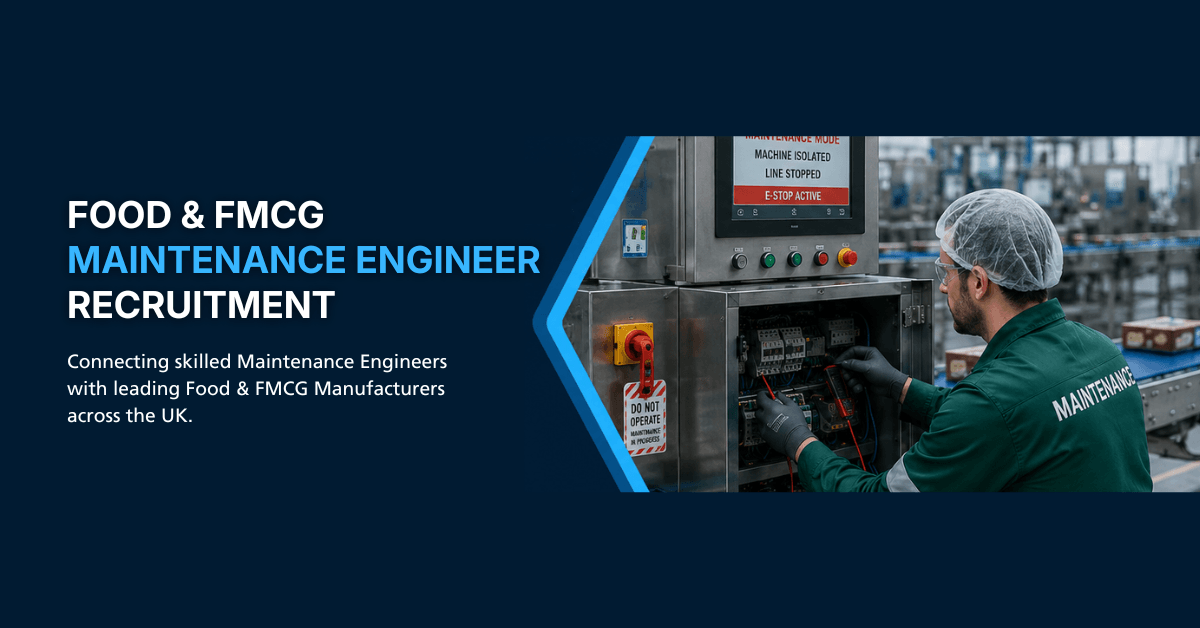
Food & FMCG Maintenance Engineer Recruitment
Specialist engineering recruitment for high-speed, automated and regulated manufacturing environments
In Food and Fast-Moving Consumer Goods (FMCG) manufacturing, a vacant maintenance role is rarely just a recruitment issue.
It is an operational risk.
When a high-speed production line is short of engineering cover, the financial penalties mount by the minute - directly impacting daily output volumes, labor planning, raw material waste, hygiene windows, changeover efficiencies, and overall equipment effectiveness (OEE)
A strong engineer in this environment does more than repair machinery. They help keep production moving, protect product safety, respond quickly to breakdowns, support planned maintenance, work safely in hygiene-critical areas and reduce repeat equipment failures.
SimWest Engineering Recruitment supports UK Food, Drink and FMCG manufacturers with permanent recruitment for hands-on engineering maintenance roles across high-speed, automated, packaging-led and regulated production environments. We help employers identify, approach and recruit maintenance professionals who can cope with the pace, machinery, standards and shift reality of live production sites.
Recruiting for a Food or FMCG Maintenance Engineer?
Submit a Vacancy or Speak with a Consultant at SimWest Engineering Recruitment.
Why maintenance hiring is different in Food and FMCG manufacturing
Recruiting an engineer for a general industrial setting is fundamentally different from finding someone who can support a modern food production or FMCG manufacturing facility.
A candidate can be technically strong and still be the wrong fit.
Engineering teams in this sector must navigate demanding operational conditions that require technical competence, urgency, safe working habits and behavioural composure. The difference is not simply the machinery. It is the pace, pressure, standards and consequences of the environment.
Employers often need engineers who can work around:
- High-speed production and packaging lines where short stoppages quickly become expensive
- Hygiene-critical areas where maintenance activity must protect product safety and cleanliness
- BRCGS, HACCP, GMP and retailer audit expectations where documentation and standards matter
- PLC-controlled automation involving sensors, drives, HMIs, safety circuits and line control systems
- 24/7 shift patterns where engineers may need to make decisions with limited support
- CAPEX projects and line upgrades where new equipment must be installed, commissioned and maintained
- PPM and reliability programmes designed to reduce repeat breakdowns and improve OEE
- Production pressure where engineering, operations, technical and quality teams must work closely together
This is why the strongest shortlist is not always the one with the most CVs.
It is the one that shows which candidates can genuinely cope with the machinery, speed, hygiene expectations, shift pattern and operational pressure of the site.
The real cost of the wrong maintenance hire
In many manufacturing environments, a poor hire creates inconvenience.
In food production and FMCG, it can create a direct production risk.
The wrong person may struggle with fast fault-finding, hygiene procedures, automated equipment, solo shift cover, communication with production teams or the pace of reactive breakdown response.
That can lead to:
- Longer breakdowns Increased product waste
- Missed production targets
- More pressure on existing engineers
- Higher contractor reliance
- Poor handovers between shifts
- Repeat faults not being properly investigated
- Reduced confidence from production and operations teams
- Greater risk around hygiene, quality or audit expectations
- Higher turnover if the role was oversold or poorly matched
For employers in this sector, the recruitment process needs to test more than whether someone has held a similar job title.
It needs to establish whether they can perform in the specific conditions of the site.
The Food and FMCG maintenance environment
Food, drink and consumer goods manufacturing sites often combine process equipment, packaging machinery, utilities, automation, hygiene controls and high-volume production targets in one environment.
A suitable engineer may need to support several areas of the plant.
Primary Processing and Production Equipment
This may include mixers, ovens, fryers, slicers, depositors, cookers, chillers, blenders, tanks, pumps, valves, pipework, conveyors and product transfer systems.
These areas often require practical mechanical maintenance skills, safe working around production and an understanding of how equipment condition affects product quality, yield and consistency.
Packaging and End-of-Line Equipment
Many sites rely on packaging machinery as much as process machinery.
Relevant equipment may include:
- Flow wrappers
- Baggers
- Cartoners
- Tray sealers
- Labellers
- Coders
- Sleevers
- Checkweighers
- Metal detectors
- Vision inspection systems
- Case packers
- Palletisers
- Conveyors and product handling systems
A breakdown in these areas can quickly create upstream disruption, product accumulation, rework, waste or missed despatch windows.
Utilities and Site Services
Some roles also involve utilities and site services.
This may include compressed air, steam, refrigeration, chilled water, boilers, pumps, effluent systems, extraction, HVAC, water treatment and wider plant infrastructure.
For employers, it is important to define whether the vacancy is mainly production-line focused, utilities focused, or a mix of both.
Automation and Controls
Modern production environments increasingly depend on automated process and packaging systems.
Candidates may need experience with:
- Electrical fault finding
- PLC fault finding
- HMI diagnostics
- Sensors
- Inverters and variable speed drives
- Servo drives
- Control panels
- Safety circuits and interlocks
- Automated line start-up and recovery Input/output diagnostics
Not every vacancy needs a Controls Engineer. However, many sites need engineers who can diagnose common automation faults, understand line logic and avoid unnecessary escalation when production is down.
Where Food and FMCG maintenance recruitment often goes wrong
Many hiring campaigns struggle because the vacancy is defined too broadly.
A job brief that says “multi-skilled engineer required for a food manufacturing site” does not provide enough detail to identify, attract or screen the right people.
Common problems include:
- Treating food manufacturing maintenance as the same as general industrial maintenance
- Advertising a role as multi-skilled without defining the real electrical or mechanical bias
- Asking for PLC experience without clarifying whether this means resets, diagnostics, interrogation or programming
- Underestimating how much shift pattern affects candidate interest
- Failing to explain the machinery, pace and working environment clearly
- Assuming food experience is always essential when transferable high-speed experience may work
- Overlooking hygiene, GMP, BRCGS or retailer audit exposure where it is genuinely important
- Focusing only on active applicants while the strongest engineers remain passive
- Ignoring commute reality for nights, rotating shifts and 4-on-4-off patterns
- Moving too slowly after identifying a credible candidate
In a competitive market, unclear hiring criteria can lead to unsuitable interviews, slow shortlists, candidate drop-outs and repeated re-advertising.
If your current vacancy is attracting the wrong applicants, SimWest Engineering Recruitment can help clarify the role, reposition the opportunity and approach relevant engineers directly.
Submit a Maintenance Engineer Vacancy
Food and FMCG engineering roles we recruit for
SimWest Engineering Recruitment supports permanent recruitment for hands-on engineering roles across Food, Drink and FMCG manufacturing sites.
Typical roles include:
- Maintenance Engineer
- Multi-Skilled Maintenance Engineer
- Electrical Maintenance Engineer
- Mechanical Maintenance Engineer
- Shift Engineer
- Engineering Technician
- Maintenance Technician
- Reliability Engineer
- Site Services Engineer
- Controls and Automation Engineer
- Hands-on Engineering Team Leader
The job title matters less than the actual role requirement.
A “Shift Engineer” in one business may be electrically biased and automation-heavy. A “Maintenance Engineer” in another may be mainly mechanical, process-led or utilities-focused.
Our role is to help define the real requirement before approaching the market.
Candidate profiles that perform well in Food and FMCG manufacturing
The strongest candidates usually bring more than technical ability.
They understand the behaviour, pace and standards expected inside a live production environment.
Production-Minded Engineers
Good engineers in this sector understand that breakdowns affect output, waste, labour, quality and customer supply.
They can prioritise effectively, communicate with operators and production leaders, and make practical decisions under pressure.
Hygiene-Aware Engineers
Manufacturing sites with food safety or hygiene-critical requirements need people who understand that maintenance activity can affect product safety.
The right candidate will take hygiene, foreign body prevention, allergen controls, clean-down procedures, tool control and documentation seriously.
Fast Fault-Finders
High-speed environments reward engineers who can diagnose quickly, isolate faults and restore production safely.
This may involve a combination of mechanical inspection, electrical testing, PLC diagnostics, operator questioning and historical fault knowledge.
Shift-Realistic Candidates
Many strong engineers will consider shifts, but only when the overall package makes sense.
Salary, shift allowance, commute, overtime, rota pattern, team size and management style all influence whether a candidate will engage and stay.
Reliability-Focused Engineers
The best maintenance hires do more than react to breakdowns.
They help identify repeat failures, improve PPM routines, support root cause analysis, reduce downtime and contribute to more reliable production.
Skills and experience we commonly screen for
Depending on the vacancy, relevant experience may include the following.
Mechanical Maintenance
- Bearings, rollers, shafts and gearboxes
- Motors, chains, belts, sprockets and drive systems
- Conveyors and product handling equipment
- Pumps, valves and pipework
- Pneumatics and hydraulics
- Mechanical strip-downs and rebuilds
- Lubrication, alignment and wear checks
- Planned inspections and component replacement
Electrical and Controls Maintenance
- Electrical fault finding
- Control panels
- Sensors, drives and inverters
- Safety circuits and interlocks
- Motors and starters
- PLC fault finding
- HMI diagnostics
- Automated production and packaging systems
- Fault recovery on line control systems
Production and Regulated Manufacturing Experience
- High-speed production lines
- Packaging machinery
- Filling and processing equipment
- Washdown and hygiene-critical areas
- BRCGS, HACCP, GMP or retailer-audited environments
- CMMS and PPM systems
- Root cause analysis
- Continuous improvement
- CAPEX project support Installation and commissioning support
We also assess whether the person’s expectations are realistic for the role, including salary, shifts, commute, overtime, notice period and long-term motivation.
Is previous food manufacturing experience always essential?
Previous food manufacturing experience can be highly valuable, particularly where hygiene, washdown, allergen controls, GMP, BRCGS or retailer audits are important.
However, it is not always the only suitable background.
Depending on the site, strong candidates may also come from:
- Packaging manufacturing
- Process manufacturing
- Automated warehousing or distribution equipment
- High-speed production environments
- Regulated manufacturing sites
The key question is not simply:
Has this person worked in food?
The better question is:
Can this engineer adapt to the pace, hygiene expectations, production pressure and equipment complexity of this specific site?
For some employers, previous food experience is essential. For others, a strong high-speed manufacturing background with the right attitude and training support may be enough.
How SimWest Engineering Recruitment approaches Food and FMCG maintenance searches
Our process is designed around the reality of production-critical engineering recruitment.
1. Line-critical vacancy briefing
We start by understanding the site, the line environment and the real engineering problem behind the vacancy.
This includes machinery, shift pattern, breakdown profile, team structure, technical bias, hygiene requirements, production pace, management style and whether the role is replacing someone, adding capacity or supporting new equipment.
2. Technical requirement definition
We help clarify what the role genuinely needs.
For example:
- Is the role electrically biased, mechanically biased or genuinely multi-skilled?
- Is PLC fault finding essential or desirable?
- Is the role mainly packaging, process, utilities or site-wide?
- Will the engineer work alone on shift?
- Is food or FMCG experience essential, or is transferable experience acceptable?
- What level of hygiene, audit or documentation experience is required?
- This prevents the search from being built around vague job titles.
3. Candidate market positioning
We assess how attractive the vacancy is compared with competing opportunities.
Engineers will weigh up salary, shift allowance, overtime, rota pattern, commute, equipment condition, site investment, training, team size and management culture.
If the offer is not aligned with the market, we provide honest feedback before time is lost.
4. Targeted search and direct approach
The best maintenance professionals are often not actively applying for roles.
We use direct sourcing, candidate networks, job boards, LinkedIn, targeted outreach and sector-specific search activity to identify engineers who may be relevant but not visible through advert response alone.
5. Practical screening
We screen candidates for more than job title and employer name.
We look at machinery exposure, fault-finding ability, production pace, hygiene awareness, shift suitability, commute reality, salary expectations, motivations and counteroffer risk.
6. Shortlist, interview and offer support
We introduce candidates with clear context, including technical strengths, limitations, expectations and practical considerations.
We then support interview coordination, feedback, offer discussions, notice periods and candidate communication through to start date.
Why manufacturers choose SimWest Engineering Recruitment
Food, Drink and FMCG employers work with SimWest Engineering Recruitment because we understand the difference between a maintenance CV and a maintenance hire who can genuinely support a live production site.
We do not just ask whether someone has worked in food manufacturing. We look at whether they understand the pace, hygiene expectations, shift demands, breakdown pressure and machinery mix of your specific site.
We help employers:
- Define the real technical requirement behind the job title Identify engineers with relevant production and packaging experience
- Separate genuine multi-skilled capability from broad CV wording
- Assess PLC, electrical, mechanical and reliability experience accurately
- Understand whether food sector experience is essential or whether transferable high-speed manufacturing experience could work
- Position vacancies clearly in a competitive candidate market
- Approach passive engineers who are not applying to adverts
- Screen for shift suitability, commute practicality and long-term fit
- Reduce the risk of short-term hires in production-critical role
- Recruit engineers who can support uptime, reliability and operational performance
Our focus is not simply to send more CVs.
It is to help employers speak with maintenance professionals who are realistic, relevant and capable of adding value in a high-pressure manufacturing environment.
When to speak with a specialist maintenance recruiter
It may be worth speaking with SimWest Engineering Recruitment if:
- Your vacancy has been advertised but applications are weak
- You need engineers with food, drink, FMCG or high-speed production experience
- You are struggling to find genuine multi-skilled capability
- You need electrical fault-finding or PLC diagnostic experience
- Your site runs nights, rotating shifts or 4-on-4-off patterns
- You are replacing a long-serving engineer with site-specific knowledge
- You are reducing contractor reliance or overtime pressure
- You are building engineering cover around new machinery or CAPEX investment
- You need better market feedback before going back out to search
A targeted search can often uncover candidates who would not apply directly but may consider the right role if it is presented clearly and realistically.
Related Maintenance Recruitment pages
As part of our wider Maintenance Engineer recruitment cluster, you may also find these pages useful:
- Maintenance Engineer Recruitment Agency UK
- Maintenance Engineer Recruitment North West
- Multi-Skilled Maintenance Engineer Recruitment
- Engineering Recruitment Agency in Manchester
- The Food and Drink Maintenance Engineer Occupational Profile
Food & FMCG Maintenance Engineer Recruitment FAQs
What is Food and FMCG Maintenance Engineer recruitment?
Food and FMCG Maintenance Engineer recruitment is the process of identifying, approaching, screening and recruiting hands-on maintenance professionals for food manufacturing, drink production, packaging and high-volume consumer goods manufacturing sites.
These roles often involve breakdown response, planned maintenance, shift cover, hygiene awareness, packaging machinery, electrical fault-finding, mechanical maintenance and production-line reliability.
How does a Food or FMCG Maintenance Engineer differ from a general industrial maintenance engineer?
Engineers in these environments often work at a faster production pace, with stricter hygiene expectations and greater pressure around downtime, waste, audit standards and customer supply.
They may need experience with high-speed packaging equipment, automated lines, washdown areas, food safety procedures, documentation and shift-based production support.
Why are Maintenance Engineers difficult to recruit for Food and FMCG sites?
They are difficult to recruit because demand is high and the strongest engineers are usually already employed.
Employers often need people who can combine production maintenance, mechanical ability, electrical fault-finding, PLC awareness, hygiene-critical working practices and shift flexibility. That combination is limited in the market.
What equipment do Food and FMCG Maintenance Engineers usually work on?
They may work on conveyors, fillers, wrappers, baggers, cartoners, checkweighers, metal detectors, vision systems, labellers, coders, palletisers, pumps, valves, pipework, ovens, mixers, depositors, chillers, utilities, motors, drives, sensors and automated production systems.
The exact equipment depends on whether the site is process-led, packaging-led, utilities-heavy or fully integrated across production and packing.
Do Food and FMCG Maintenance Engineers need PLC experience?
Some do, but the required level varies.
Many sites need engineers who can carry out PLC fault finding, diagnose inputs and outputs, understand HMI messages and recover automated lines safely. Full PLC programming may only be required for more controls-focused roles.
The level of PLC responsibility should be clearly defined before recruitment begins.
Is previous food manufacturing experience essential?
Previous food manufacturing experience is highly useful where hygiene, washdown, BRCGS, HACCP, GMP, allergen controls or retailer audit standards are important.
However, some employers can consider candidates from beverage, pharmaceutical, packaging, FMCG, process manufacturing or other high-speed production environments if they have the right maintenance skills and can adapt to food safety expectations.
What makes a Food or FMCG Maintenance Engineer vacancy more attractive?
Clear salary information, realistic shift patterns, strong overtime structure, investment in machinery, a supportive engineering culture, training, manageable commute and honest expectations all improve candidate engagement.
Engineers are more likely to respond when they can quickly understand the equipment, shift pattern, team structure, site environment and long-term stability of the role.
Can SimWest Engineering Recruitment support urgent maintenance vacancies?
Yes. SimWest Engineering Recruitment supports single critical maintenance vacancies and wider shift-team recruitment for Food, Drink and FMCG manufacturing employers.
Urgent searches still need a clear brief, realistic market positioning and targeted approach, especially when the right candidates are already employed and not actively applying for jobs.
Speak with a Food & FMCG Maintenance Engineer recruiter
If you are struggling to recruit Maintenance Engineers, Shift Engineers, Multi-Skilled Engineers, Electrical Maintenance Engineers or Reliability Engineers for a Food, Drink or FMCG manufacturing site, SimWest Engineering Recruitment can help.
We support UK manufacturers with permanent recruitment for hands-on engineering maintenance roles in production-critical environments.
Submit a Maintenance Engineer Vacancy
Speak with a specialist Engineering Recruitment Consultant