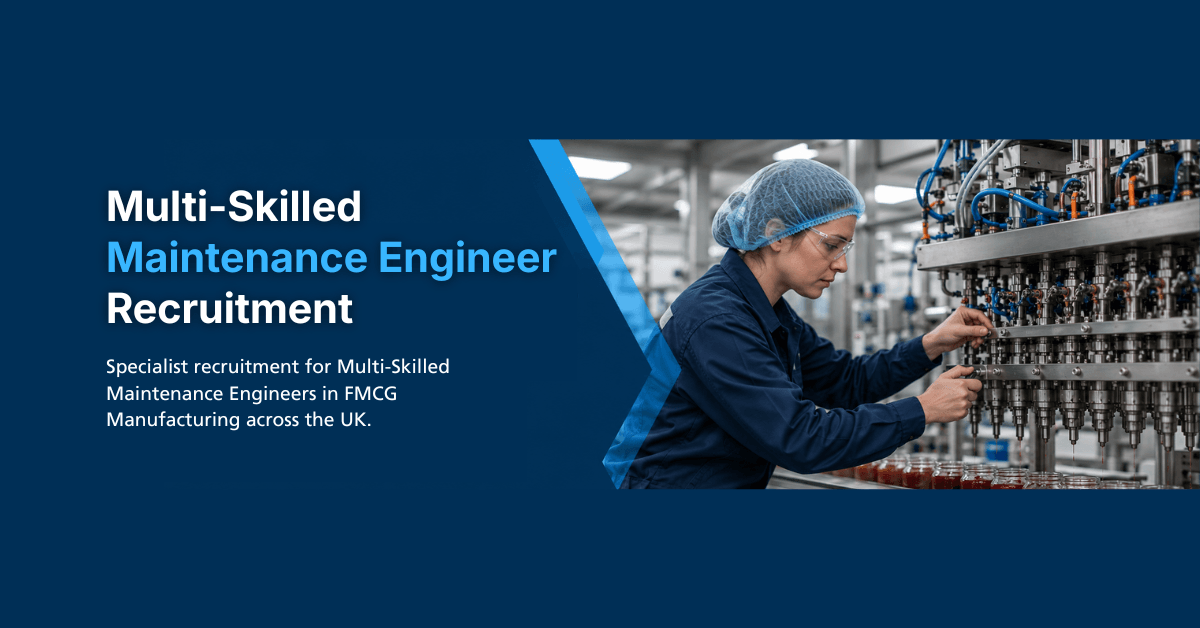
Multi-Skilled Maintenance Engineer Recruitment
Specialist Recruitment for Mechanically and Electrically Capable Maintenance Engineers
For Food, Drink and FMCG Manufacturing employers, recruiting a genuinely Multi-Skilled Maintenance Engineer has become one of the hardest hands-on engineering hires to complete.
The issue is not just finding someone with the right job title. It is finding someone who can safely fault-find across electrical and mechanical systems, support production under pressure, and add real cover to an already stretched engineering team.
Employers do not simply need engineers who can “cover maintenance.” They need practical, hands-on people who can respond quickly to breakdowns, support planned maintenance, work safely around production teams and keep critical equipment running.
With experienced engineers in short supply, employers are competing for a limited pool of people who are often already well-paid, settled and likely to receive a counter-offer if they resign.
SimWest Engineering Recruitment supports Food, Drink and FMCG Manufacturing employers with one of the most difficult maintenance hires in the market: finding engineers who are genuinely capable across both mechanical and electrical disciplines.
We help identify and approach hands-on maintenance professionals who can fault-find in live production environments, support planned maintenance, reduce pressure on stretched shift teams and contribute to long-term machinery reliability.
Why Multi-Skilled Maintenance Engineers Are Difficult to Recruit
Recruiting a Multi-Skilled Maintenance Engineer is rarely a simple CV search.
The title itself can be misleading. Many engineers describe themselves as multi-skilled, but their practical experience may lean heavily toward a mechanical or electrical bias. For employers, this lack of standardised capability makes rigorous technical screening absolutely non-negotiable.
Some candidates are excellent mechanical engineers with basic electrical awareness. Others are strong electrical engineers who can fault-find safely around control panels, sensors, drives and automated systems, but have had limited exposure to mechanical strip-downs, bearings, gearboxes, pumps, pneumatics or hydraulics.
For employers, the challenge is not only finding someone with relevant experience. It is understanding whether that person can genuinely support the specific machinery, shift pattern, production demands and fault conditions on your site.
This is especially important in manufacturing environments where downtime has an immediate impact on output, customer orders, food safety, product quality, compliance and pressure on the wider team.
Typical hiring challenges include:
- A national shortage of experienced maintenance engineering talent
- An ageing workforce with long-serving engineers approaching retirement
- A limited pipeline of new apprentices entering hands-on engineering roles
- High demand for engineers with both mechanical and electrical competence
- Fierce competition between manufacturers for the same candidate pool
- Increased salary expectations for genuinely multi-skilled engineers
- Counter-offers from current employers when strong candidates resign
- Difficulty assessing whether a candidate is truly multi-skilled or simply carries the title
In this market, employers need a recruitment process that looks beyond keywords and tests whether the candidate’s experience matches the practical reality of the site.
The Multi-Skilled Supply and Demand Gap
The shortage of dual-skilled maintenance professionals is part of a wider challenge across UK manufacturing.
Manufacturing sites are becoming more automated, more data-led and more reliant on production-critical equipment. Lines often include conveyors, filling systems, wrappers, checkweighers, inspection equipment, pumps, motors, drives, sensors, control panels and PLC-controlled systems.
At the same time, many engineering teams still rely on a relatively small number of experienced engineers who have built up years of site knowledge.
When those engineers retire, move on or reduce their hours, businesses can lose far more than a job title. They lose fault history, machine knowledge, practical workarounds, supplier familiarity and the confidence that comes from understanding how the site actually runs.
The apprenticeship pipeline has not fully closed that gap.
Many manufacturers would like to grow their own engineering talent, but apprentices take years to develop into fully independent engineers. They need structured training, mentoring, exposure to real breakdowns and time alongside experienced maintenance professionals.
That creates a persistent supply and demand problem.
Manufacturers need engineers who can add value now. The market is producing too few people with the right blend of mechanical ability, electrical confidence, production awareness and shift-based maintenance experience.
As A Result, Genuinely Capable Multi-Skilled Engineers Remain In Constant Demand.
What Does a Good Multi-Skilled Maintenance Engineer Look Like?
A strong Multi-Skilled Maintenance Engineer is not necessarily someone who is perfectly balanced across every discipline.
In most real manufacturing environments, engineers still have a natural bias. They may be electrically biased, mechanically biased or stronger in automation, but they should have enough cross-discipline capability to support the needs of the site.
The right balance depends on your machinery, engineering team structure and shift cover.
Mechanical maintenance capability
Mechanical skills may include experience with:
- Bearings, shafts, rollers and gearboxes
- Conveyors and product handling systems
- Pumps, valves and pipework
- Pneumatics and hydraulics
- Motors and drive systems
- Filling, packing and wrapping machinery
- Mixers, blenders and process equipment
- Mechanical strip-downs and rebuilds
- Planned preventative maintenance
- Root cause analysis and reliability improvements
Electrical maintenance capability
Electrical skills may include experience with:
Electrical fault finding
- Control panels Motors, sensors and inverters
- Drives and automation systems
- PLC fault finding
- Safety circuits and interlocks Instrumentation and control systems
- Production line electrical breakdowns
- Basic control system diagnostics
- Working safely around live manufacturing environments
Production maintenance experience
In Food, Drink and FMCG Manufacturing, technical ability alone is not enough.
The best engineers understand the pressure of live production. They can communicate with operators, prioritise urgent faults, work safely under time pressure and make practical decisions that protect uptime without compromising standards.
They understand that a breakdown is not just an engineering issue. It affects output, labour planning, waste, quality, hygiene, despatch and customer commitments.
Why “Multi-Skilled” Must Be Properly Defined Before Recruiting
Before starting a Multi-Skilled Maintenance Engineer recruitment campaign, employers should be clear on what the role actually requires.
A vague brief such as “we need someone multi-skilled” can lead to wasted time, poor shortlist quality and unsuitable interviews.
A more effective brief should define:
- Whether the role is electrically biased, mechanically biased or genuinely balanced
- The level of electrical fault finding required
- Whether PLC fault finding is essential or desirable
- The type of production machinery on site
- The split between reactive breakdowns and planned maintenance
- Whether the engineer will work alone on shift
- The level of support available from other engineers
- The shift pattern, overtime and call-out expectations
- The sector background required
- Whether the site can train gaps or needs immediate competence
This clarity helps attract the right people and prevents candidates from being oversold into roles that do not match their strengths.
It also helps employers understand whether they are looking for a ready-made engineer or someone with the right foundation to develop.
Solving the Multi-Skilled Gap: The Cross-Training Strategy
Waiting for a perfectly balanced 50/50 engineer can leave critical shift vacancies open for longer than most manufacturers can afford.
Those candidates do exist, but they are rare. They are also usually well looked after by their current employers.
For many manufacturers, the more realistic strategy is to identify the strongest available technical foundation and then develop the missing skills through structured cross-training.
That may mean hiring an electrically biased engineer and strengthening their mechanical skills. It may mean hiring a mechanically strong engineer and developing their electrical awareness. It may also mean building a team with complementary strengths rather than expecting every individual to be equally strong in every area.
Cross-training is one of the most practical ways for manufacturers to reduce their long-term reliance on a limited external candidate market.
Instead of waiting for the perfect candidate to appear, employers can build capability internally by developing engineers who already have the right attitude, fault-finding mindset and production maintenance foundation.
This works particularly well when training is structured, realistic and linked to the machinery on site.
Examples include:
- Pairing electrical engineers with experienced mechanical engineers during planned maintenance
- Giving mechanical engineers controlled exposure to electrical fault-finding under supervision
- Using OEM training on specific production equipment
- Building skills matrices around real site assets
- Creating clear development routes from biased engineer to broader maintenance capability
- Documenting common faults and repair procedures
- Encouraging knowledge transfer before senior engineers retire
- Linking pay progression to proven cross-discipline competence
Cross-training will not solve an urgent vacancy overnight, but it can reduce future hiring pressure and improve retention by giving engineers a visible development path.
Why Electrical Engineers Can Often Cross-Train Well into Mechanical Maintenance
In many manufacturing environments, it is often easier to develop an Electrical Engineer into broader mechanical maintenance than it is to develop a Mechanical Engineer into a fully competent electrical fault-finding role.
That does not mean mechanical engineering is simple. Mechanical maintenance still requires practical judgement, experience, dexterity, fault diagnosis and a strong understanding of machinery.
However, electrical engineering often involves a more abstract technical foundation. Electrical engineers are used to working with circuits, logic, signal paths, control systems, invisible failure modes and mathematical principles that are not always physically obvious.
That type of thinking can transfer well into mechanical problem-solving.
An engineer who is already comfortable diagnosing electrical faults, interpreting systems, following logic and working safely around complex equipment often has a strong cognitive base for learning mechanical principles such as motion, force, friction, alignment, wear, load, power transmission and component failure.
There is also a safety and risk argument.
Mechanical awareness can often be developed through supervised exposure to machinery, planned maintenance, component replacement, strip-downs, rebuilds and practical mentoring.
By contrast, developing someone into a safe and confident electrical fault finder can take longer, particularly where live panels, control systems, drives, PLCs and safety circuits are involved.
For this reason, many employers are open to electrically biased maintenance engineers who can grow their mechanical capability over time.
The key is not to assume that every Electrical Engineer will naturally become mechanically strong. The right person still needs hands-on aptitude, curiosity, humility And A Willingness To Get Involved With The Practical Realities Of Maintenance Work.
When A Mechanically Biased Engineer Can Be the Right Choice
A mechanically biased engineer can still be an excellent hire, particularly on sites where the main challenges involve mechanical breakdowns, conveyors, bearings, gearboxes, pumps, pneumatics, hydraulics, product handling systems or process machinery.
Many Food, Drink and FMCG Manufacturing sites rely heavily on mechanical maintenance capability.
However, if the role involves lone working, shift cover, control panel fault finding, automated line diagnostics or regular electrical breakdowns, employers need to be clear about how much electrical responsibility the person will be expected to carry.
A mechanically biased engineer with basic electrical awareness may be suitable for some sites, but not for others.
The most important point is alignment.
The candidate’s real capability must match the risk, responsibility and support structure of the role.
How Simwest Engineering Recruitment Supports Multi-Skilled Maintenance Engineer Hiring
SimWest Engineering Recruitment supports UK manufacturers with permanent recruitment for Multi-Skilled Maintenance Engineers and related hands-on engineering roles.
We do not simply search for candidates using the phrase “multi-skilled.”
We clarify whether the role needs electrical fault-finding, mechanical breakdown cover, PLC confidence, lone-working capability, regulated manufacturing experience or a realistic development pathway.
That distinction matters because many engineers carry the same job title, but bring very different levels of practical capability.
Our approach helps employers understand what they need, what the candidate market can realistically provide and how to position the opportunity effectively.
- Role briefing: We clarify the role requirements, shift pattern, salary range, machinery, site environment, engineering team structure and technical expectations.
- Market positioning: We assess how attractive the vacancy is compared with competing employers, considering salary, shifts, overtime, commute, training, call-out expectations and site culture.
- Targeted candidate search: We identify and approach relevant engineers through direct sourcing, our network, job boards, LinkedIn and targeted outreach.
- Technical screening: We look beyond the words “multi-skilled” and assess the candidate’s actual mechanical, electrical and production maintenance capability.
- Motivation and counter-offer assessment: We explore why the candidate is considering a move, what they need from their next role and how likely they are to accept and remain in the position.
- Shortlist and interview support: We provide clear candidate context so employers understand strengths, limitations, salary expectations, notice periods and long-term fit before interview.
Multi-Skilled Maintenance Roles We Recruit For
SimWest Engineering Recruitment supports employers recruiting for roles including:
- Multi-Skilled Maintenance Engineers
- Electrically Biased Maintenance Engineers
- Mechanically Biased Maintenance Engineers
- Shift Engineers
- Maintenance Engineers
- Engineering Technicians
- Maintenance Technicians
- Site Services Engineers
- Reliability Technicians
Whether you need one critical hire or several engineers for a shift-based manufacturing site, we can help you approach the market more effectively.
Manufacturing Sectors We Support
We recruit maintenance professionals for production-led manufacturing environments across the UK, including:
- Food and Drink Manufacturing: Supporting employers with maintenance recruitment across high-speed production, packaging lines, hygienic environments, filling equipment, conveyors, inspection systems and production-critical breakdowns.
- FMCG Manufacturing: Helping high-volume manufacturers recruit engineers who can support fast-paced production, automated lines, wrapping, packing, labelling, filling and continuous improvement activity.
- Process Manufacturing: Supporting batch and continuous process environments involving pumps, valves, pipework, mixers, blenders, utilities, motors, drives and production equipment.
- Pharmaceutical and regulated manufacturing: Recruiting engineers who understand the importance of compliance, documentation, hygiene, quality standards and safe working practices in regulated production environments.
Why Employers Work With Simwest Engineering Recruitment
We do not treat Multi-Skilled Maintenance Engineer recruitment as a generic keyword search.
Employers work with SimWest Engineering Recruitment because we understand the difference between a candidate who has the right title and a candidate who can genuinely support the technical and operational demands of a live manufacturing site.
We help employers:
- Distinguish between mechanical, electrical and genuinely multi-skilled engineers
- Assess whether the candidate’s experience matches the real site requirement
- Understand whether salary, shift pattern, commute and overtime expectations are realistic
- Approach passive engineers who may not be actively applying for roles
- Reduce the risk of unsuitable interviews and short-term hires
- Position vacancies clearly in a competitive candidate market Identify people who can add value, stay long term and strengthen engineering cover
A candidate may look strong on paper, but the placement can still fail if the shift pattern, commute, salary expectations or site culture are not realistic long term.
That is why we focus on the practical details that determine whether a hire is likely to work beyond the interview stage.
Related Maintenance Recruitment Pages
As part of our wider Maintenance Engineer recruitment services, you may also find these pages useful:
- Maintenance Engineer Recruitment Agency UK
- Maintenance Engineer Recruitment North West
- Food & FMCG Maintenance Engineer Recruitment
- Engineering Recruitment Agency in Manchester
- Maintenance Engineer Occupational Profile
- One Interview or Two for Maintenance Engineers?
Multi-Skilled Maintenance Engineer Recruitment Faqs
What is a Multi-Skilled Maintenance Engineer?
A Multi-Skilled Maintenance Engineer is a hands-on engineer who can support both mechanical and electrical maintenance activity within a manufacturing or production environment.
In practice, most engineers still have a natural bias, but a strong multi-skilled engineer should be able to contribute across breakdowns, planned maintenance, fault finding and production support.
Why are Multi-Skilled Maintenance Engineers hard to recruit?
They are difficult to recruit because demand is high and supply is limited.
Many experienced engineers are already employed and regularly approached by competing manufacturers. The shortage is particularly acute for engineers who can combine electrical fault finding, mechanical maintenance, PLC awareness and production environment experience.
Should we hire an electrically biased or mechanically biased engineer?
That depends on your site, machinery and team structure.
If your biggest risk is electrical breakdowns, automation faults, control panels, sensors, inverters, drives or PLC fault finding, an electrically biased engineer may be more suitable.
If your site is more mechanically intensive, a mechanically biased engineer may be the better fit.
The key is to define the real requirement before going to market.
Is cross-training a good way to build multi-skilled capability?
Yes. Cross-training can be an effective long-term strategy, especially where employers already have strong engineers with the right attitude and learning ability.
It works best when supported by mentoring, OEM training, structured skills matrices and exposure to real site equipment.
Is it easier to train an Electrical Engineer in mechanical skills?
In many manufacturing environments, yes.
Electrical engineers are often used to abstract problem-solving, systems thinking, diagnostics and complex fault-finding. That can provide a strong foundation for learning mechanical principles such as motion, force, load, wear, alignment and component failure.
However, the individual still needs practical aptitude and a willingness to develop hands-on mechanical skills.
Which maintenance engineering path offers the best career outlook?
The strongest career outlook is usually for engineers who can combine electrical fault finding, mechanical maintenance and production environment experience.
Electrically biased maintenance engineers are particularly in demand because of the growth of automation and control systems, but mechanically strong engineers who Continue Developing Electrical Skills Also Have Strong Opportunities.
Speak With a Multi-Skilled Maintenance Engineer Recruiter
If you are struggling to recruit Multi-Skilled Maintenance Engineers for a Food, Drink, FMCG, Pharmaceutical or Process Manufacturing site, SimWest Engineering Recruitment can help.
We support UK manufacturers with permanent recruitment for hands-on engineering maintenance roles, from single critical vacancies through to wider shift-team recruitment.
Speak with SimWest Engineering Recruitment about your next Multi-Skilled Maintenance Engineer hire.